

How to Use the American Morse Code Translator
Four short steps. The other box updates as you type.
- Type in either box. Words go in Plain text. American Morse goes in the other box, with . - = and _. A space sits inside C, O, R, Y, and Z. One slash is the next letter. Two slashes are the next word.
- Read the other box. It fills in as you type. Swap only moves which box is on the left.
- Press Play. Choose the telegraph sounder or the CW tone. Pause holds your place, Stop goes back to the start, and Download saves that sound as a WAV.
- Copy, share, or listen. Copy sits inside each box. Under the player you can clear the message, copy a share link, or copy a puzzle link. The Listen tab reads a microphone or an audio file on this device.
What Is American Morse Code?
American Morse code is the original dots-and-dashes alphabet that Samuel Morse and his partner Alfred Vail built for the telegraph in the late 1830s. To work out which letters needed the shortest signals, Alfred Vail reportedly walked into a local newspaper’s print shop and counted how much metal type the printers kept on hand for each letter. The most common ones, like E, got the simplest codes. The code went into real public use on May 24, 1844, the day Morse sent his first long-distance message over the Washington-to-Baltimore line.
It stayed the standard on American and Canadian telegraph lines and railroads for nearly a century, which is why most people today call it Railroad Morse. Trains, newspapers, and stock prices all moved through it long before radio existed. Railroad telegraphy, and with it everyday use of the code, was fading out by the 1970s.
It is a separate Morse code from the one most people picture when they hear the word “Morse” now. Ships, the military, and radio operators today use a later European redesign known as International Morse. This page covers the older American Morse code, with its own alphabet, its own timing, and its own translator above.
Why Is It Called Railroad Morse?
It wasn’t called Railroad Morse in 1844. It was just Morse code, because there was no other kind. The “American” label showed up later, once Europe had its own version and people needed a way to tell the two apart. “Railroad” came after that, most likely because the railroads were where the code kept working the longest.
The link to trains goes back to the very first message. Morse sent it from Washington on May 24, 1844, and Vail received it in the Baltimore and Ohio Railroad depot in Baltimore. Even so, trains weren’t run by telegraph yet. That changed on September 22, 1851, when Charles Minot, a superintendent on the Erie Railroad, got stuck waiting for another train at Turner, New York, and used the line to tell the next station to hold it. It is generally counted as the first train order ever sent by telegraph.
Within a few decades, depots up and down the line had a telegrapher on staff. They took orders from a dispatcher somewhere down the line and reported back as trains went by. At first, those orders were sent in American Morse. The person tapping at the station window was a railroad employee, and it’s easy to see why the name stuck.
Watch: American Morse Code in Action
A short look at this page: typing American Morse, playing the telegraph sounder and the CW tone, and reading the code back.
What Is an American Morse Code Translator Tool?
This translator takes a message and converts it into American Morse, or reads American Morse and turns it back into plain text. The difference from an ordinary Morse translator is the alphabet underneath. Letters, numbers, and the timing between them follow the older Railroad Morse rules, not the International code most tools default to.
Text to Morse
Type or paste a message, and it converts into American Morse as you go. Characters that don’t exist in American Morse, or symbols the system can’t represent, show up as “#” instead of silently dropping them.
Morse to Text
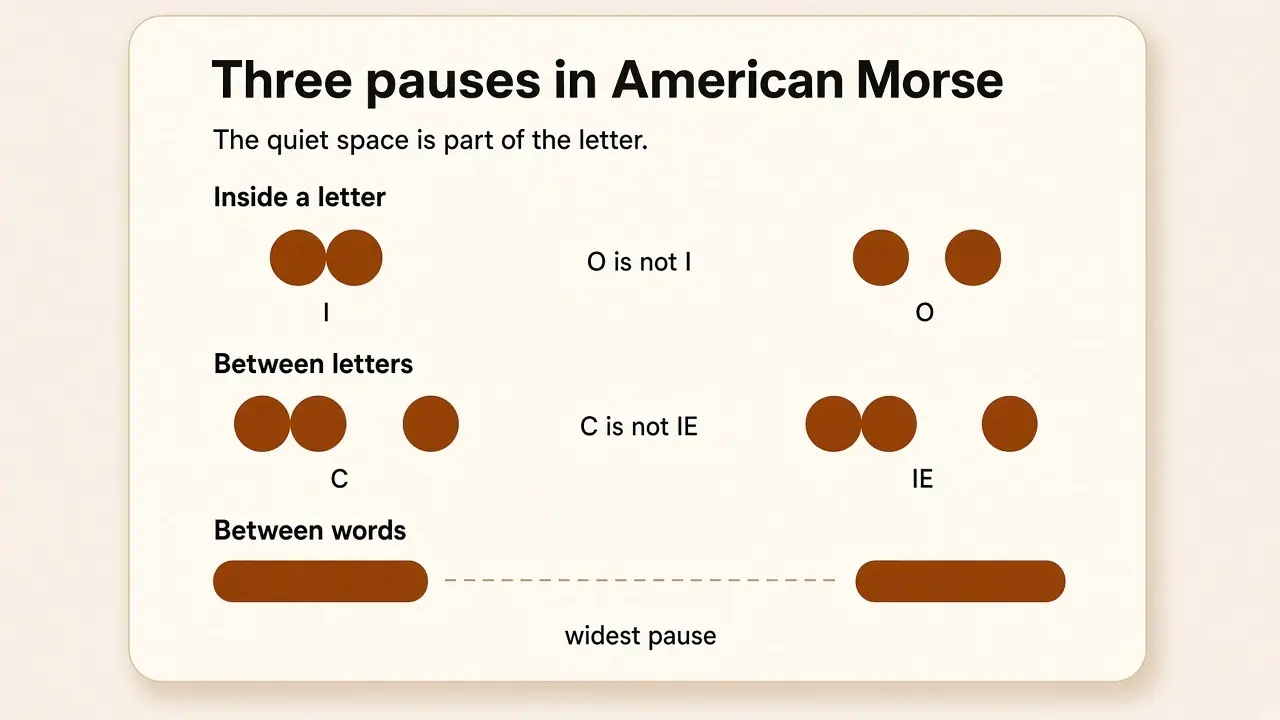
Paste American Morse in, and it reads back out as plain text. Some letters use a pause inside a single character, like C or O. The tool needs a clear way to tell that short internal gap apart from the gap between two letters, or it will misread one letter as two.
Sound, Light, and Vibration
Play the message as sound, with a choice between two listening styles: the old click of a telegraph sounder, or a smoother CW tone closer to what you’d hear on radio. The dock border pulses with the CW tone only, and it never flashes the whole page. Vibration works with the sounder or the tone, so you can see or feel the signal as well as hear it.
Speed, Volume, and Pitch
Adjust how fast the code plays, how loud it is, and the pitch of the tone. American Morse uses more than one dash length, not a single fixed dash like International Morse, so speed changes the full shape of the signal, not only how quickly one dash follows another. Pitch applies to the CW tone. It stays visible, and does nothing, while the telegraph sounder is selected.
How the American Morse Code Tool Works
Matching a Letter to Its Code
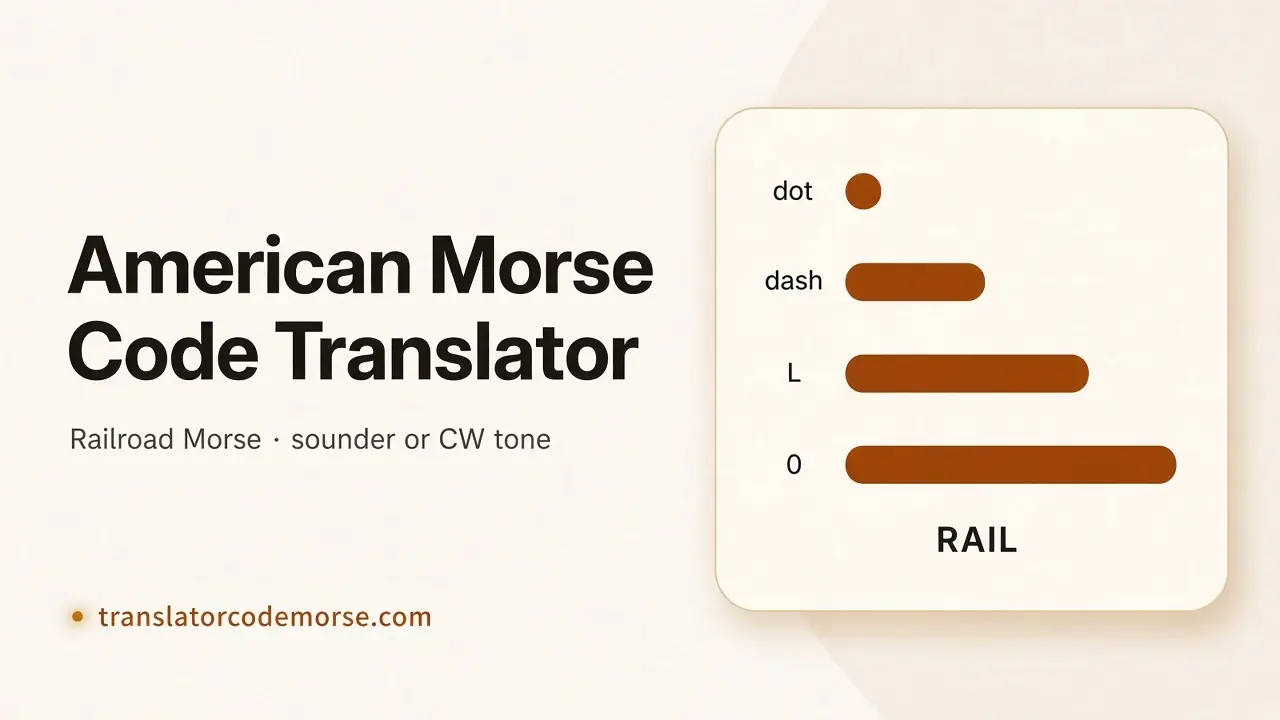
Type a letter, and the tool checks it against a table and sends back the matching code. International Morse only needs two shapes, a dot and a dash. American Morse needs four: the dot, a regular dash, a longer dash for L, and an even longer dash for the number 0. The tool has to pick which of those four it is looking at and build it correctly.
Reading the Code Back
Reading the code back is harder. C and O each have a pause inside the character, not between two characters. If the tool treats that pause as a letter break, it reads C as two letters instead of one, and the rest of the message falls apart from that point on. It keeps three pause lengths straight at once: the one inside a letter, the one between letters, and the one between words.
Why Speed Changes Everything at Once
Slide the speed up or down and the tool isn’t just speeding up one dash. It stretches or shrinks the dot, each dash length, and all three pauses together, in the same ratio. A dot stays shorter than a dash, which stays shorter than L, which stays shorter than 0. Get that ratio off and the output stops sounding like American Morse.
American Morse Code Chart: Letters, Digits, and Punctuation
Here is the full chart: all 26 letters, the ten digits, and the punctuation marks this translator uses. A dot is “.”, a dash is “-”, “=” is the long dash for L, and “_” is the extra-long dash for 0. A space inside a code is a real pause, longer than the normal gap between dots and dashes, so “. .” is the letter O and “..” is I. Operators did vary, so treat this as the form this page encodes and decodes, not the only form ever printed.
Type a dot as ., a dash as -, L as
=, and 0 as _. A single space is the pause inside a
letter. One slash (/) is the next letter, and two slashes
(//) are the next word. That is the same notation as the Morse box above. Some
charts print L as ⸺ and 0 as ⸻. You can paste those symbols. This page reads them, then shows = and _.
Letters (A to Z)
Five letters hide a pause inside them: C, O, R, Y, and Z. The easiest way to remember them is to treat each one as two small letters stuck together. C is I then E, O is E then E, R is E then I, Y is I then I, and Z is S then E. L is the other odd one out, a single long dash. The remaining twenty letters use only ordinary dots and dashes, and fifteen of those twenty are identical to the International Morse alphabet.
| Letter | Code | Letter | Code |
|---|---|---|---|
| A | .- | N | -. |
| B | -... | O | . . |
| C | .. . | P | ..... |
| D | -.. | Q | ..-. |
| E | . | R | . .. |
| F | .-. | S | ... |
| G | --. | T | - |
| H | .... | U | ..- |
| I | .. | V | ...- |
| J | -.-. | W | .-- |
| K | -.- | X | .-.. |
| L | = | Y | .. .. |
| M | -- | Z | ... . |
Digits (0 to 9)
The International Morse numbers always run to five marks, which makes them easy to learn. American digits follow no such rule. 0 is one mark, 5 is three dashes, and 6 is six dots, so each digit has to be learned on its own. Only 4 matches the International version.
| Digit | Code | Digit | Code |
|---|---|---|---|
| 0 | _ | 5 | --- |
| 1 | .--. | 6 | ...... |
| 2 | ..-.. | 7 | --.. |
| 3 | ...-. | 8 | -.... |
| 4 | ....- | 9 | -..- |
Punctuation
Punctuation is where American Morse gets odd. Several marks are letter patterns joined into one token, with no
pause inside: the slash is U then T (..--), the hyphen is H then X
(.......-..), and the colon is K, E, then E (-.-..).
Some manuals put a space between those letter groups. This translator does not. Type the code exactly as the
table shows. In this punctuation table, a space belongs only in the ampersand and the semicolon. These codes are the hardest to hear and the
easiest to misread, since every pause has to be the right length.
There’s also a trap for anyone who knows International Morse. ..--.. is a question
mark there, but in American Morse it is a period. And -..-., a slash in
International Morse, is the question mark here.
| Mark | Code | Mark | Code |
|---|---|---|---|
| Period | ..--.. | Colon | -.-.. |
| Comma | .-.- | Semicolon | ... .. |
| Question mark | -..-. | Apostrophe | ..-..-.. |
| Exclamation mark | ---. | Slash | ..-- |
| Hyphen | .......-.. | Ampersand | . ... |
| Open parenthesis | .....-. | Close parenthesis | ......... |
| Open quotation mark | ..-.-. | Close quotation mark (”) | ..-.-.-. |
The close quotation mark is the curly quote ”, not the straight quote used for the open quotation mark. That is how the two can round-trip as different characters. Nine dots is the close parenthesis. Five dots is the letter P.
How to Read American Morse: Gaps, Long Dashes, and Sounder Clicks
Reading American Morse by ear works nothing like reading a chart. A trained operator doesn’t count dots and dashes while a message comes in. They hear a letter as one shape, the same way you hear a spoken word instead of spelling it out. That’s the point of hearing the code live instead of only looking at it on a page.
Every operator also had their own rhythm, and other operators could tell who was sending just by the feel of it. Telegraphers called this a person’s “fist.” One might rush the last dot in R just slightly, another might leave a touch more air inside C than the textbook says. Shipboard operators used this same trick to guess whether someone on the other end was sending from a boat getting tossed around in rough weather. It’s one more reason a live sounder, and not a chart, was the real way to learn this code.
Why Does American Morse Sound Like Clicks Instead of Beeps?
A telegraph sounder doesn’t hum a tone the way a radio does. It has a metal arm that snaps down against a contact when the circuit closes, making a click, then snaps back up when the circuit opens, making a clack. A dot is a quick click-clack. A dash is a click, a pause, then a clack, and the pause is what you’re actually measuring.
That’s a different skill from listening for a steady beep. Instead of one continuous sound changing length, you’re timing the gap between two short mechanical snaps. Early operators got good enough at this to read entire sentences without thinking about it, the same way a fluent reader doesn’t sound out each letter of a word.
There’s an odd theory tied to this timing. Some researchers think the QWERTY keyboard layout was shaped partly by how American Morse operators typed up incoming messages, since a few letter pairs sound so close that a typist needed certain keys kept apart to avoid mixing them up while copying fast. Nobody treats this as settled fact, but it’s a reminder of how deeply this code’s timing shaped the tools around it.
A CW tone, the smooth radio-style beep most people now associate with Morse, carries the same dots and dashes without the clicking mechanism. The translator above lets you switch between the two, so you can hear the code the way a 19th-century operator did, or the way a modern radio operator would.
How American Morse Differs From International Morse
Both codes are built from dots and dashes, which is exactly why people mix them up. The same pattern can mean a different letter in each one. Send dash, dot, dash, dot and an International operator writes C, while an American operator writes J. Read a message with the wrong code and you won’t get a slightly wrong answer. You’ll get gibberish.
The Differences at a Glance
The split wasn’t a clean upgrade. Gerke’s German code cut out the long internal pauses and the two long dashes, and it changed eleven letters and most of the numbers along the way. That simpler version handled undersea cables better, because American Morse packs in lots of closely spaced dots that blur together on a long cable. Europe made it the standard in 1865, and radio followed once ships needed one shared code, which a London conference settled in 1912. US landline companies kept American Morse anyway, partly because it sent faster and they didn’t want to retrain their operators.
| American Morse | International Morse | |
|---|---|---|
| Dash lengths | Three kinds: regular, long (L), and longer (0) | One |
| Pauses inside a letter | Yes, in C, O, R, Y, and Z | None |
| Who designed it | Samuel Morse and Alfred Vail, in use from 1844 | Friedrich Gerke, Germany, 1848 |
| Works best over | Overhead land wires | Undersea cables, then radio |
| Speed | Faster to send, thanks to shorter dashes | Slower, but holds up better over long distances |
| Where you’ll see it now | Telegraph clubs, railroad museums, Civil War reenactments | Almost all Morse use today, ham radio included |
Which Letters Are Different?
Eleven letters change between the two codes: C, F, J, L, O, P, Q, R, X, Y, and Z. The other fifteen are identical, so a message made only of A, B, D, E, G, H, I, K, M, N, S, T, U, V, and W reads the same in both. Among the digits, only 4 matches.
In the table below, = is the long dash for L, and a gap inside a code is a real pause. So . . (O) is two dots with a pause between them, not the letter I (..).
| Letter | International | American |
|---|---|---|
| C | -.-. | .. . |
| F | ..-. | .-. |
| J | .--- | -.-. |
| L | .-.. | = |
| O | --- | . . |
| P | .--. | ..... |
| Q | --.- | ..-. |
| R | .-. | . .. |
| X | -..- | .-.. |
| Y | -.-- | .. .. |
| Z | --.. | ... . |
The real danger is overlap. These five patterns exist in both codes, but they point to different characters.
| Pattern | International | American |
|---|---|---|
| -.-. | C | J |
| .-.. | L | X |
| .--. | P | 1 |
| ..-. | F | Q |
| .-. | R | F |
Can I Convert International Morse Directly Into American Morse?
Not by swapping symbols one for one, because the same pattern often means a different character. Eleven letters and nine of the ten digits change between the two codes, and most punctuation does too. Read the International code for CAT with the American chart and you get JAT. OX comes out as the number 59.
Go through plain text instead, because a letter is the same letter in both codes. Only the dots and dashes differ. It takes two steps:
- Decode the International Morse into text with the main Morse code translator.
- Paste that text into the translator on this page to get American Morse.
The same path works the other way around. Decode American Morse here, then paste the text into the main Morse code translator for International Morse. Check numbers and punctuation afterwards, since those are where the two codes disagree the most.
Who Should Use an American Morse Code Converter?
Most people don’t need American Morse. If you want Morse for radio, ships, or a standard chart, International Morse is the one you’re after. This page is for the smaller group who need the older code on purpose, usually because of a piece of history, a hobby, or a project that has to get the details right.
- Railroad and telegraph history fans. You can check or write messages in the code that actually ran on the railroads.
- Reenactors and museum volunteers. It helps anyone staging a historical demonstration who wants the sound of a real telegraph office.
- Writers, game makers, and prop designers. A period story needs the right dots and dashes, and International Morse would be wrong for a US railroad scene.
- Ham radio operators. It’s a way to hear the old landline code and the clicks of a sounder without owning one.
- Teachers and students. A telegraph history lesson works better when students can hear the real code, not just read about it.
Is American Morse Code Still Used Today?
Not for real work. Railroads moved on to the telephone, and later to radio and electronic signals. The last train order ever copied in Morse is said to have come in at Whitehall, Montana, on May 6, 1982. Ham radio followed a similar path: American operators once used both codes on the air, and now almost all of them use International.
What’s left is mostly a hobby. The Morse Telegraph Club is a non-profit that works to preserve American Morse, and its members include retired railroad telegraphers, ham operators who got pulled toward landline telegraphy, and people who just like the history. Some chapters meet in old railroad stations and send messages to other chapters on real sounders. Back in the 1990s, members of one Illinois club converted old modems so they could send Morse over phone lines.
It isn’t growing quickly. A British Columbia chapter closed in 2018, and one member called them a dying breed. But a club at Heritage Park in Calgary started in 2019 with help from retired telegraphers, and its junior members are keeping the code going. You’ll also still hear American Morse in railroad museums and Civil War reenactments. If you want to hear it without owning a sounder, the telegraph sounder setting in the translator above does the job.
Is American Morse Harder to Learn Than International Morse?
A little harder to hear, yes, and the cause is timing. International Morse has one dash length and one size of pause inside a letter. American Morse has three dash lengths and three pause lengths: inside a letter, between letters, and between words. The pause inside a letter is the only thing that tells C from IE and R from EI, and old learning guides warned that run-together letters were easy to misread. Telegraphers had a word for the resulting slips, hog-Morse, from the classic example of HOME arriving as HOG.
For someone who already knows International Morse, the bigger problem is interference. Fifteen letters and the digit 4 are the same in both codes, but everything else clashes, so your memory keeps offering the wrong answer. A ham radio training book with a chapter on learning the old code gives one rule: keep the two codes in separate boxes. Never think “that’s C in International, so it must be J.” It also says to hear the code properly sent first, because the rhythm is different.
The same book is encouraging about the rest. Reading by sounder, it says, is no harder than reading by tone, and anyone who has learned one code already knows how to learn another. So if you’re starting from zero, International Morse is the more practical first code, because far more people use it. Come to American Morse after that, and use the sounder setting at a slow speed to get the rhythm of the pauses in C, O, R, Y, and Z.
Notes
This translator follows one standard version of American Morse, the one most commonly taught by Morse history groups today. Real operators varied quite a bit in their timing, and some old manuals disagree on a few marks, especially in punctuation. If a message you’re checking against an old document doesn’t match exactly, that’s likely why.
Typing American Morse by hand needs a way to mark the pause inside a letter separately from the pause between
letters. This tool uses . for a dot, - for a dash,
= for the long dash (L), and _ for the extra-long
dash (0). A single space is the pause inside a letter, such as C or O. A forward slash marks the gap between
letters, and a double slash marks the gap between words. The Morse box says the same thing: “.- for A, space
inside C O R Y Z, / between letters, // between words.” The Type tab keys are labeled “L long dash” and “0
extra-long dash.” If you paste Morse copied from somewhere else, you may need to adjust it to this format first.
Pasted ⸺ and ⸻ are accepted as L and 0, then shown as = and _.
The dock border pulses with the CW tone, not the telegraph sounder, and it never flashes the whole page. A sounder’s click and clack don’t map cleanly onto a single flash the way a steady tone does. Vibration works with either sound setting.
The “#” symbol stands in for any character this tool doesn’t have a code for. If you see one in your output, check the text you typed for a symbol outside the chart above.
Frequently Asked Questions
Is American Morse the same code used in old war movies or by the navy?
No. Films and military history almost always use International Morse, since that is what ships, the military, and radio operators adopted after 1912. American Morse was a landline code, used over wires on the ground, not over radio or at sea.
Do I need a real telegraph key or sounder to use this tool?
No. Everything runs in your browser. The sound settings let you hear a telegraph sounder or a CW tone without any hardware.
Why does American Morse have more than one length of dash?
It comes from how the code was first built for a mechanical sounder, not a tone. A longer dash was a simple way to add letters and digits that a single dot and a single dash could not tell apart.
How do I type the long dashes for L and 0?
Type = for L, the long dash, and _ for 0, the extra-long dash. On the Type tab, the keys labeled “L long dash” and “0 extra-long dash” insert them. You can also paste the chart symbols ⸺ and ⸻. This page reads ⸺ as L and ⸻ as 0, then shows = and _.
Can this tool read American Morse from an audio recording?
Yes. Open the Listen tab above this article. Start listening uses the microphone, or you can drop in a WAV, MP3, or OGG file. Decoding stays in your browser and follows American Morse timing. The separate audio translator on this site is built for International Morse, so use this page for railroad Morse.
Why did my message come out as nonsense?
The most common cause is mixing up the two codes. Check whether the source was written in International Morse, since reading one code with the other code’s rules rarely gives a sensible result. The section above on converting between the two codes explains how to check.
Conclusion
American Morse isn’t the Morse code most people picture, and that’s exactly why it still has fans. It belonged to railroads and landlines, had its own rhythm of clicks, and stayed in daily use decades after the rest of the world moved to something simpler. This page exists so that history, a hobby, or a project doesn’t have to stop at “I wish I could read this.”
Related pages
- Morse code audio translator
Decode International Morse from a recording or a microphone.
- Morse code image translator
Read International Morse from a photo. It does not read American Morse.
- SOS in Morse code
The distress signal is International Morse, not railroad Morse.